
BC Bee Atlas Data Summary - 2024
Specimens were collected by volunteer Master Melittologists who hand-netted bees from flowers. Bee specimens were retained, pinned, labelled, and submitted to the BC Bee Atlas for identification. The flowers that bees were collected on were photographically documented using the citizen science platform iNaturalist, which produces bee-plant association records. Bee specimens collected from a single species of plant on a single day comprised one sampling event. A plant host could not be identified for 561 specimens. These bees are included in the number of specimens collected, but have no associated sampling event.
Bee surveying

Survey effort over the 2024 field season: the number of survey days, sampling events and specimens collected by volunteer Master Melittologists on behalf of the BC Bee Atlas.
Survey locations

Regional Districts where wild bees were collected by Master Melittologists for the Bee Atlas over the 2024 field season. Bees were collected in 12 of BC's 27 Regional Districts. BC maps gov.bc.ca, created with R and Quarto.
Bee diversity
The five most frequently collected species were Bombus flavifrons (196 specimens), Bombus vancouverensis (168), Bombus melanopygus (80), Agapostemon subtilior (73), and Halictus tripartitus (71), comprising 23% of all specimens collected. Just one specimen was collected for 32 of the 136 species identified.
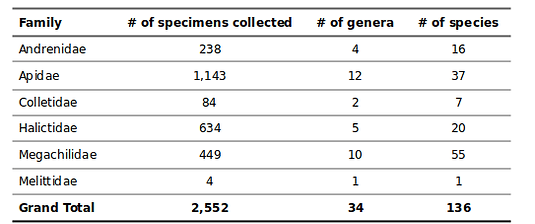
Number of specimens collected in each family, along with their distribution across genera and species.


Rank abundance plots of specimens collected for the BC Bee Atlas during the 2024 field season.
Plant associations
In 2024, Bee Atlas volunteers collected 1975 bee plant association records via iNaturalist (note some bees specimens do not have an associated plant observation). bees were collected on plants from 40 plant families, comprising 130 plant genera and 141 plant species.


The 10 plant families and genera where the greatest diversity of bee species were collected by Master Melittologist volunteers during the 2024 field season.
Species at risk
The provincial Conservation Status Rank uses letters and numbers to categorize the risk species are at of disappearing.
Based on rank, species are assigned to red, blue and yellow lists that help identify species that are or may become endangered or threatened (BC Conservation Data Centre, accessed Dec 2025). Species with insufficient data for ranking are categorized as Unrankable.
-
Red list - species that are extirpated (locally extinct), endangered, or threatened.
-
Blue list - species that are at risk and considered to be of special concern.
-
Yellow list - species that are apparently secure and not at risk of extinction.
There are currently three species on the red list Bombus bohemicus, Bombus suckleyi, and Dufourea dilatipes. Bee Atlas volunteers have yet to collect these species. However, 20 species on the Blue List were collected in 2024. In addition to ranked species, Master Melittologists collected 40 wild bee species in 2024 that are currently Unranked. A rank will be assigned when it becomes clear whether these species are native, introduced, or accidental in BC. The Bee Atlas is contributing important information to BC's wild bee knowledge base.

Blue-listed species collected for the BC bee Atlas during the 2024 field season.

Bombus terricola © rushingriverbees

Megachile fidelis © Lori Weidenhammer
Non-native species
Bee Atlas volunteers collected 222 bee specimens that are not native in BC, for a total of 12 of the known non-native species.

Bombus impatiens © kathq

Non-native species collected for the BC Bee Atlas during the 2024 field season.
Specialist species
Specialist bees may forage on just one or two species of plants (narrow oligolecty), while others forage on multiple species often from within a single plant family (broad oligolecty). Thirty three specialist bee species known in BC were collected in 2024 (list developed with reference to Jarrod Fowler’s work on pollen specialist bees).


Andrena astragali © Elora

Megachile pugnata © Blythe Nilson
Specialist bee species collected for the BC Bee Atlas during the 2024 field season.